Portfolio Update
Portfolio Update (July 2025)
12 July 2025
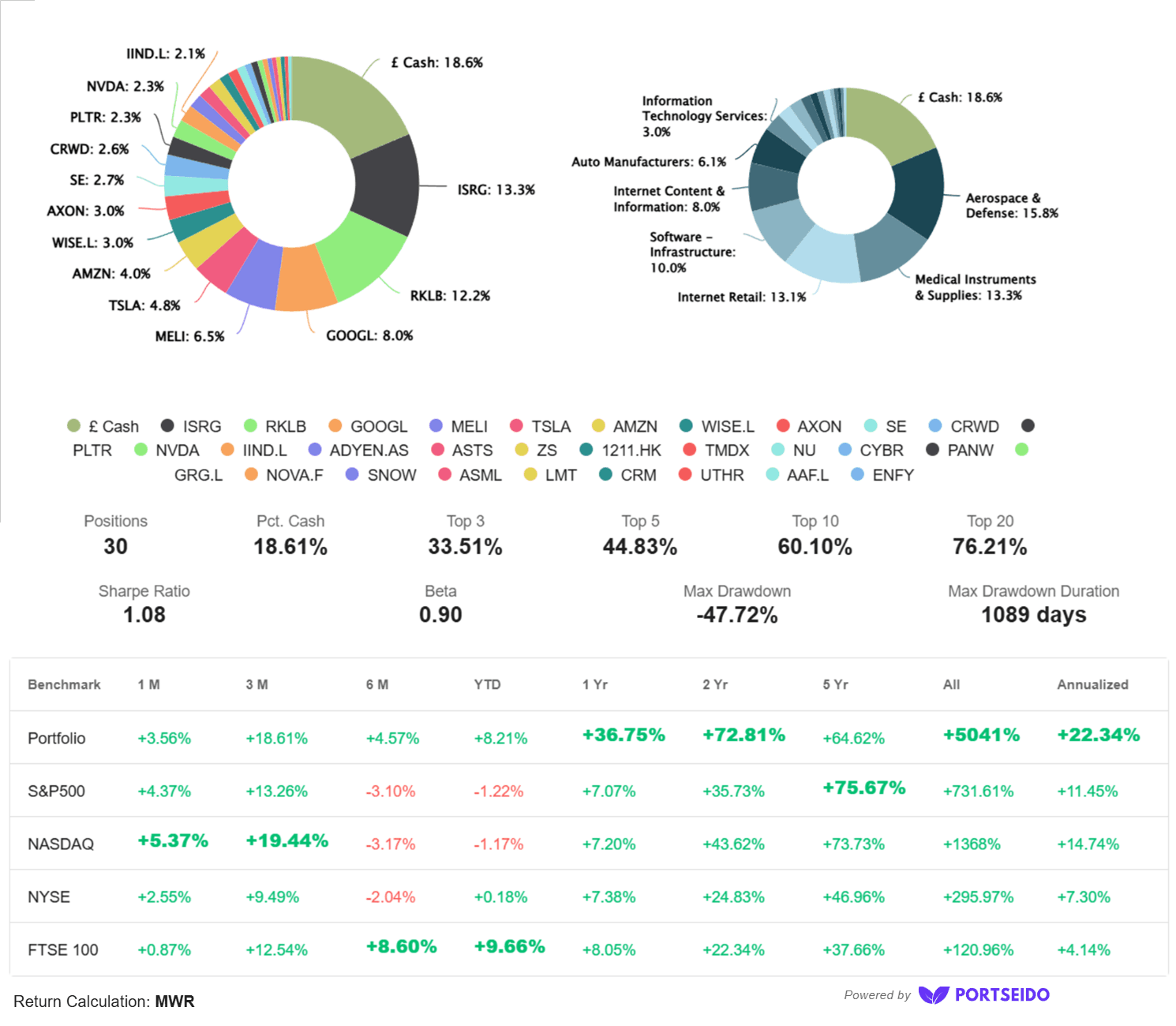
I've generated a 22% CAGR over 21 years by investing in world-class companies committed to shaping a better future. Here's everything I own today: [Jul 2025]
⭐ = high conviction ⬆️ = bought / added ⬇️ = trimmed / sold
- $CASH - Cash - 18.8%
- $ISRG - Intuitive Surgical - 13.2%
- $RKLB - Rocket Lab - 12.2% ⭐
- $GOOGL - Alphabet - 8.0% ⭐
- $MELI - MercadoLibre - 6.5% ⭐
- $TSLA - Tesla - 4.8%
- $AMZN - Amazon - 4.0% ⭐
- $AXON - Axon - 3.0%
- $WISE - Wise - 3.0%
- $SE - Sea Ltd - 2.6% ⭐
- $CRWD - Crowdstrike - 2.6%
- $PLTR - Palantir - 2.3%
- $NVDA - NVIDIA - 2.3% ⭐
- $IIND - India ETF - 2.1% ⭐
- $ADYEN - Adyen - 1.8%
- $ASTS - AST SpaceMobile - 1.6%
- $ZS - Zscaler - 1.6%
- $BYDDY - BYD - 1.3%
- $TMDX - TransMedics - 1.2%
- $NU - Nubank - 1.1% ⭐
- $CYBR - CyberArk - 0.8% ⬆️
- $PANW - Palo Alto - 0.8%
- $GRG - Greggs - 0.6% ⬆️
- $NVO - Novo Nordisk - 0.6%
- $SNOW - Snowflake - 0.6%
- $ASML - ASML - 0.6%
- $LMT - Lockheed Martin - 0.5%
- $CRM - Salesforce - 0.5%
- $UTHR - United Therapeutics - 0.5%
- $AAF - Airtel Africa - 0.4%
--
Two new buys this month! Greggs $GRG has been on my watchlist since 2023, and last week's price drop offered a tempting bargain. This is a 100-year-old British brand with a strong employee culture, a clear growth strategy, and a healthy, stable dividend. While I'm not expecting multi-baggers from this investment, it neatly supports my strategy of pivoting a little more towards income, so it's finally time to get onboard!
The company has taken a hit recently due to increasing employee costs in the UK and slowing sales growth, largely attributed to affordability concerns (and also, last week, the weather ☀️). However, I actually feel Greggs will be somewhat resilient in a recession. It's not gourmet food, but it's undeniably cheap.
My due diligence from two years ago revealed a seamless and impressive buying experience. While their famous steak bake was decent and the vegan sausage roll acceptable, their coffee remains, in my opinion, amongst the worst I've ever drunk. This isn't a healthy choice, nor a brand I'd personally frequent, but it is deeply embedded in British culture and certainly has its fans. I'm happy to finally be an owner, even if I'm not an avid customer.
--
At the start of last year, I had a ~10% allocation to cybersecurity as an investment theme. With the recent trimming of Crowdstrike $CRWD due to valuation concerns, that dropped as low as 5.4%, making it a prime target to increase exposure, albeit in companies that offer slightly better value than $CRWD, $PANW, or $ZS.
This month I added CyberArk $CYBR to my portfolio, the Gartner and Forrester leader for Privileged Access Management. I particularly noted its "digital vault" for credentials, and the Privileged Session Manager, which acts as a secure proxy for privileged sessions, allowing credential obfuscation, comprehensive monitoring, and strong audit trail. CYBR's leadership in privilege management makes perfect sense to me in a world increasingly dominated by non-human identities (in recent reporting, non-human identities outnumber humans by 80x and rising).
--
In the round, I plan to increase my exposure to small-cap tech, particularly software. The Fed is likely to start cutting rates in the next few quarters in pursuit of the long-term rate target of 2%. This is generally positive for equities, especially growth sectors such as technology, where future cash flows are more critical to the investing thesis, and thus more heavily impacted by changes to the risk-free rate.
While mega-cap tech stocks are nearing peak valuations (with a few exceptions such as $GOOGL which still offers compelling long-term upside), smallcap tech has been overlooked to some extent, and I'll occasionally see an attractive entry point for stocks on my radar.
I'm particularly drawn to software companies, as these are largely immune from the chaos of tariffs (they typically don't involve the buying or selling of physical goods). Their primary cost base is labour, and the accelerating rise of 'digital employees' – essentially AI-driven automation – is set to significantly amplify margins by reducing the need for human intervention in many processes.
An investor needs to be judicious however, as many software segments are at risk of being replaced by AI, rather than simply enabled by it. I feel strongly that cybersecurity is one of those sectors. It's likely to be one of the last functions that businesses would consider bringing in-house, if only for the reputation of the CTO. Who wants to take on that responsibility, risk a breach, and then have to explain to the Board why a DIY approach was superior to buying in acknowledged, industry-leading solutions? The CTO has effectively outsourced both the solution and the blame, a pragmatic reality in enterprise IT. 🤷
My recent investment in CyberArk $CYBR directly reflects this conviction, offsetting the recent trimming I've made to CrowdStrike $CRWD as a consequence of its stretched valuation.
With this very recent purchase, my overall exposure to cybersecurity as a megatrend has risen back to 6%, I'd really like to get this closer to 8-10% by year end.
--
I have no plans to trim my position in Tesla $TSLA, but this is no longer a high conviction holding. While I ultimately hope that success simply boils down to execution and the company's ability to scale out robotaxi services and begin to generate economic value from Optimus, Elon's escalating political involvement presents a concerning variable. He previously stated he would step away from politics post-DOGE, but the recent announcement that he's planning to fund the "America Party" is the biggest step he's taken into the political arena to date. This move, particularly his public spat with the current administration and threats to challenge lawmakers, does not bode well for shareholders if he follows through.
There are many things the current administration could do to hamper the company, given Tesla's reliance on government policies, tax credits, contracts for its growth, and also loosening regulations for physical AI (cars and robots). The main saving grace is simply that actively hindering Tesla could slow AI progress in the US versus China. Ultimately, I would hope that the broader national interest in maintaining AI leadership will override any personal grudge between the administration and Musk.
Until Elon can evidence that he's lost his distraction with politics, I'm taking a more cautious stance.
--
Before I close, a quick note on performance: my year-to-date return currently stands at 8.21%. This figure, however, isn't directly comparable to what a domestic US investor with the same portfolio history might see. If I were to recalculate the entire portfolio in US Dollars, my YTD return would rise to 14.69%. While I prefer to stick to my local currency for consistency and to reflect my actual purchasing power, it's fascinating to note the profound impact that currency movements, specifically the weakening of the US Dollar over the last six months, has had on headline returns. This illustrates the often-overlooked factor of currency risk (and opportunity!) when investing internationally.
And by the way, weakening is a oft-misunderstood term in the current economic context, and the recent movement in FX actually serves the current administration's goals.
A "weaker dollar" makes US exports more competitive globally, as American goods become cheaper for foreign buyers. This stimulates demand for US products, boosts domestic manufacturing, and can help to narrow the trade deficit, potentially leading to higher corporate profits and, consequently, increased tax revenues for the government.
A weaker dollar also means that the interest payments and principal repayments on the substantial portion of US debt held by foreign entities are effectively less expensive for the US Treasury (when the dollar weakens, foreign holders of dollar-denominated US debt effectively receive less of their own currency back when interest or principal payments are made). This acts as an indirect form of debt reduction, despite the nominal value remaining the same.
--
I believe and transparency and accountability, and post my full portfolio and returns every month. I also have a weekly podcast with @7FlyingPlatypus where I dive deeper into the rationale for all my trades.